Mahak Sethia


Poetics of Growth and De-Growth
A research inquiry into stillness, de-growth, fragility, and becoming.
Rethinking Growth
Growth is often associated with speed, productivity, expansion, and constant visibility. But what happens when we allow things to slow down, dissolve, soften, or remain unresolved?
This research explores stillness and de-growth not as absence or failure, but as spaces of transformation, reflection, and renewal. Through painting, observation, ecology, philosophy, and material inquiry, I examine how erosion, fragility, silence, and suspended moments can hold their own quiet form of power.

IN THE pause WE bloom
Stillness
Silence
Slowness
Strength

In my own life, degrowth has taken many forms. Sometimes it’s saying no to overproduction. Sometimes it’s allowing a painting to remain unresolved, not out of laziness but because its ambiguity is more honest than any resolution I could force upon it. Sometimes it’s choosing silence in a conversation, allowing space for someone else’s truth.
There is a quiet kind of courage in shrinking. A deep intelligence in erosion. As stones wear down into sand, as leaves rot into soil, as memories soften into feeling, the world teaches us that decay is not the opposite of life, but its necessary partner. Stillness is not the end of movement, but its threshold.
STILLNESS as Resistance
In a world driven by acceleration, visibility, and constant productivity, stillness can become a form of resistance. Silence becomes space. Rest becomes attention. Slowness becomes another way of seeing.
Philosophical ideas surrounding impermanence, duration, and ecological interconnectedness strongly shape this research. I am drawn toward practices that embrace fragility, repetition, softness, and incompleteness rather than perfection or permanence.
The sensation of time slowing down has become central to my practice.
Material, texture & FORMS
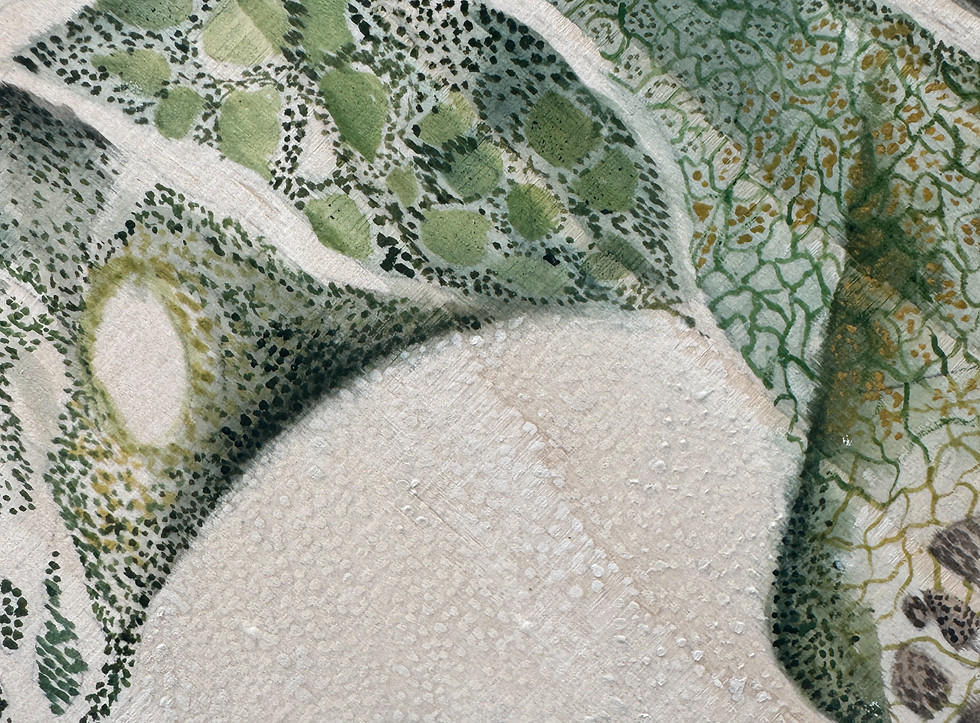
Much of my visual language emerges through close observation of microscopic and organic systems. Cellular structures, spores, fungi, roots, geological textures, erosion patterns, stains, and layered surfaces become starting points for paintings that move between scientific observation and emotional memory.
These forms are never translated literally. Instead, they become metaphors for vulnerability, healing, transformation, memory, and interconnectedness.
Layering, staining, dissolving, repetition, and scraping allow the paintings to feel grown rather than constructed. Surfaces behave almost like ecosystems, unstable, porous, shifting, and continuously becoming.
Fragile NETWORKS of Becoming
.jpg)
The microscopic structures I paint are not simply scientific references, but emotional and autobiographical metaphors. Personal experiences begin to merge with ecological systems. The body becomes landscape. Surface becomes memory.
Layered pigments, fragmented textures, dissolving forms, and unstable marks mirror the ways human experiences are continuously shaped, altered, and rebuilt over time.
Nothing grows alone.

Microscopic
Autobiographies
This idea of autobiography moves away from direct storytelling and instead explores identity through observation, material, and process. Using the microscope as both a visual and conceptual tool, my work investigates the layered, fragmented, and constantly shifting nature of the self. Cells, textures, stains, and eroded surfaces become metaphors for memory, vulnerability, transformation, and interconnectedness.
Through painting, the act of close looking begins to mirror introspection, where material exploration becomes a way of understanding embodiment and emotional experience. Rather than presenting identity as fixed or complete, these works approach the self as porous, unstable, and continuously shaped through its relationship with the surrounding world.
This research, like the paintings it reflects, remains unfinished. And that is intentional. Because to speak of growth and de-growth is to speak of process, not outcome. To value the incomplete as an honest mirror of life’s ongoing flux. To celebrate transformation, not as a final state but as an ever-returning motion.
Unfinished
as Offering

Growth, I have come to realise, is not always visible. It does not always announce itself. Sometimes it looks like stillness. Sometimes it looks like a loss. Sometimes it looks like waiting in the dark for the next breath to arrive. But it is there. Always there.
Unfolding. Returning. Becoming.